


Selected edited books
Edited volumes covering numerical methods, scientific computing, and related research areas.
2014
Patterns for Parallel Programming on GPUs
Editors: F. Magoulès.
Publication: Saxe-Coburg Publications · 2014 · English.
ISBN: 978-1-874672-57-9.
Book description
With contributions from: M. Amini, C. Ancourt, F. Andzembe, V. Arslan, R. Barrere, M. Barreteau, J.-M. Batto, F. Boumezbeur, M. Bourgoin, F. Catthoor, E. Chailloux, H.-P. Charles, J.-M. Chauvet, A. Cohen, S. Contassot-Vivier, R. Couturier, B. Creusillet, G.JL Colin de Verdiere, V. Ducrot, J.I. Gomez, D.R.C. Hill, F. Irigoin, J.C. Juega, R. Keryell, J. Koko, J.-L. Lamotte, E. Lenormand, V. Lomuller, F. Magoules, E. Mahe, S. Monot, J. Passerat-Palmbach, T. Saidani, B. Starynkevitch, F. Tahi, D. Tello, S. Tempel, C. Tenllado, V.D. Tran, S. Verdoolaege, S. Vialle, and L. Ziane Khodja.
Multi-core and many-core platforms lead the computer industry, forcing software developers to adopt new programming paradigms, in order to fully exploit their computing capabilities such as Graphics Processing Units (GPUs). GPU-based application development requires a great effort from application programmers. On one hand, they must take advantage of the massively parallel platform in the problem modeling. On the other hand, the applications have to make an efficient use of the heterogeneous memory system, managing several levels that are software or hardware controlled. Generally the programmers' methodology consists in evaluating several mapping alternatives, guided by their experience and intuition, which becomes inefficient for software development and maintenance.
This volume presents in thirteen chapters some methodologies and design patterns for parallel programing on GPUs, to help the programmers to make the good choices. Each chapter, written by different authors, presents a state-of-the-art of some innovative methods, techniques or algorithms, usefull for GPU computing. A bibliography is included at the end of each chapter.
The main topics considered in the book include: CUDA and OpenCL programming langage, parallelizing compilers generating code, dynamic code generation, parallel skeletons, high level data flow models, optimizing source code, and numerical methods. The book includes details of the implementation of the algorithms as well as both academic and real engineering examples.
2011
Computational Fluid Dynamics
Editors: F. Magoulès.
Publication: Chapman & Hall/CRC · 2011 · English.
ISBN: 978-1-4398-5661-1.
Book description
With contributions from: F. Alauzet, J. Boudet, A. Carboussat, S. Camarri, A. Dervieux, F. Godeferd, G. Jouvet, B. Koobus, F. Le Boeuf, F. Magoules, J.-C. Marongiu, H. Ouvrard, M. Picasso, J. Rappaz, M.-V. Salvetti and S. Wornom.
Exploring new variations of classical methods as well as recent approaches appearing in the field, Computational Fluid Dynamics demonstrates the extensive use of numerical techniques and mathematical models in fluid mechanics. It presents various numerical methods, including finite volume, finite difference, finite element, spectral, smoothed particle hydrodynamics (SPH), mixed-element-volume, and free surface flow.
Taking a unified point of view, the book first introduces the basis of finite volume, weighted residual, and spectral approaches. The contributors present the SPH method, a novel approach of computational fluid dynamics based on the mesh-free technique, and then improve the method using an arbitrary Lagrange Euler (ALE) formalism. They also explain how to improve the accuracy of the mesh-free integration procedure, with special emphasis on the finite volume particle method (FVPM). After describing numerical algorithms for compressible computational fluid dynamics, the text discusses the prediction of turbulent complex flows in environmental and engineering problems. The last chapter explores the modeling and numerical simulation of free surface flows, including future behaviors of glaciers.
The diverse applications discussed in this book illustrate the importance of numerical methods in fluid mechanics. With research continually evolving in the field, there is no doubt that new techniques and tools will emerge to offer greater accuracy and speed in solving and analyzing even more fluid flow problems.
2010
Substructuring Techniques and Domain Decomposition Methods
Editors: F. Magoulès.
Publication: Saxe-Coburg Publications · 2010 · English.
ISBN: 978-1-874672-33-3.
Book description
With contributions from: H. Akiba, J.M. Bahi, R. Couturier, C.-H. Lai, D. Laiymani, Y. Maday, F. Magoules, T. Miyamura, K. Moriya, T. Nodera, D. Rixen, A. Suzuki, M. Tabata, C. Venet and L. Zhang.
Domain Decomposition methods are well suited for parallel computations. Indeed, the division of a problem into smaller subproblems, through artificial subdivisions of the domain, is a means for introducing parallelism. Domain Decomposition and Substructuring strategies include in one way or another the following ingredients: - a decomposer to split a mesh into subdomains using different heuristics ; - local solvers (direct or iterative, exact or approximate) to find solutions for the subdomains for specific boundary conditions on the interface ; - interface conditions (weak or strong) enforcing compatibility and equilibrium between overlapping or non-overlapping subdomains ; - a solution strategy for the interface problem. The differences between the methods lies in how those ingredients are actually put to work and how they are combined to form an efficient solution strategy for the problem at hand.
This volume presents in nine Chapters a selection of some Domain Decomposition and Substructuring methods. The main topics considered in the book include: parareal in time algorithm, transformation methods and induced parallel properties for the temporal domain, asynchronous iterative methods, asynchronous sub-structuring methods, asynchronous multi-splitting methods, parallel iterative methods, coarse grid conjugate gradient, multi-point constraints in domain decomposition methods, approximate inverse preconditioning techniques, congruent sub-domains, linear and non-linear problems.
The topics covered in this book are wide ranging and demonstrate the extensive use of substructuring and domain decomposition methods in fluid mechanics, structural mechanics, and computational finance.
2009
Fundamentals of Grid Computing: Theory, Algorithms and Technologies
Editors: F. Magoulès.
Publication: Chapman & Hall/CRC · 2009 · English.
ISBN: 978-1-4398-0367-7.
Book description
With contributions from: L. Arantes, J.M. Bahi, X. Besseron, M.-S. Bouguerra, C. Cerin, R. Couturier, H. Fkaier, T. Gautier, F. Legond-Aubry, F. Magoules, T.M.H. Nguyen, J.-M. Pierson, E. Saule, P. Sens, A. Sider, J. Sopena, L.-A. Steffenel, F. Teng, D. Trystram and L. Yu.
The integration and convergence of state-of-the-art technologies in the grid have enabled more flexible, automatic, and complex grid services to fulfill industrial and commercial needs, from the LHC at CERN to meteorological forecasting systems. Fundamentals of Grid Computing: Theory, Algorithms and Technologies discusses how the novel technologies of semantic web and workflow have been integrated into the grid and grid services.
The book explains how distributed mutual exclusion algorithms offer solutions to transmission and control processes. It also addresses the replication problem in data grids with limited replica storage and the problem of data management in grids. After comparing utility, grid, autonomic, and cloud computing, the book presents efficient solutions for the reliable execution of applications in computational grid platforms. It then describes a fault tolerant distributed scheduling algorithm for large-scale distributed applications, along with broadcasting algorithms for institutional grids. The final chapter shows how load balancing is integrated into a real-world scientific application.
Helping readers develop practical skills in grid technology, the appendices introduce user-friendly open source software written in Java. One of the software packages covers strategies for data replication in the grid. The other deals with the implementation of a simulator for distributed scheduling in grid environments.
The various technology presented in this book demonstrates the wide aspects of interest in grid computing as well as the many possibilities and venues that exist in this research area. This interest will only further evolve as numerous exciting developments still await us.
2008
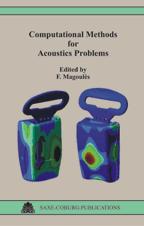
Computational Methods for Acoustics Problems
Editors: F. Magoulès.
Publication: Saxe-Coburg Publications · 2008 · English.
ISBN: 978-1-874672-30-2.
Book description
With contributions from: X. Antoine, J. Astley, A. Bendali, R. Djellouli, O. von Estorff, M. Fares, M. Guddati, P. Kunthong, K.-W. Lim, F. Magoules, M. Markiewicz, K. Meerbergen, F.-X. Roux, S. Subbarayalu, L. Thompson, E. Turkel, A. Zahid and O. Zaleski.
With the advances in high performance computing, computational acoustics and computational vibro-acoustics have gained momentum because they provide the most natural route for accurate noise prediction. The computation of acoustic phenomena is regarded today as one of the most challenging in scientific computation. Both discretisation methods and numerical schemes continue to be investigated, developed and applied to various industrial problems. This volume presents in eleven chapters key computational methods for acoustics and vibro-acoustics problems. Each chapter, written by different authors, presents a state of the art of well-established or innovative methods, techniques or algorithms. A bibliography is included at the end of each chapter.
The examples covered in this book are wide-ranging and demonstrate the extensive use of computational methods for acoustics and vibro-acoustics problems both in bounded and unbounded domains.
The main topics considered in the book include: boundary element methods, infinite elements, perfectly matched discrete layers, absorbing boundary conditions, on-surface radiation conditions, optimal interface conditions, stabilized time-discontinuous Galerkin methods, model reduction methods, iterative methods for acoustics problems in unbounded regions, inverse acoustics problems, substructuring methods for coupled vibro-acoustics problems, acoustics eigenvalue problems, validation of numerical methods in acoustics, and acoustic scattering.
2007
Techniques of Scientific Computing for Energy and the Environment
Editors: F. Magoulès and R. Benelmir.
Publication: Nova Science Publishers · 2007 · English.
ISBN: 978-1-60021-921-4.
Book description
With contributions from: K. Harada, M. Kawahara, M. Kallenberg, E. von Lavante, F. Magoules, F. Okulicka, Dluzewska, R. Putanowicz and T. Yamauchi
Research and development in scientific computing and computational science has considerably increased the power of numerical simulation. Engineers and researchers are now able to solve large and complex problems which were impossible to solve in the past. This book presents some techniques, methods and algorithms for solving engineering problems arising in energy and environment applications.
The main topics considered in the book include: multiplication of plankton, geological bassin modelling, large data visualization for environmental problems, flow around a propeller, supersonic combustion, finite element method, fictious domain method, high performance computing.
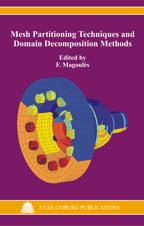
Mesh Partitioning Techniques and Domain Decomposition Methods
Editors: F. Magoulès.
Publication: Saxe-Coburg Publications · 2007 · English.
ISBN: 978-1-874672-29-6.
Book description
With contributions from: L. Champaney, M. Cross, D. Dureisseix, L. Giraud, F. Hulsemann, T. Knopp, J. Kruis, C. Lacour, G. Lube, R. Banos Navarro, G. Nikishkov, C. Gil Montoya, F. Magoules, R. Putanowicz, G. Rapin, F.-X. Roux, M. Sarkis, D.B. Szyld, R. Tuminaro and C. Walshaw.
Domain decomposition provides computationally efficient parallel and distributed solution of large scale problems. These methods mainly consist of splitting the global domain into several sub-domains and to compute the solution on the global domain through the resolution of the problem associated with each sub-domain. The aspect ratio of the sub-domains and the shape of the interface between the sub-domains have a significant influence on the convergence of domain decomposition methods. This volume presents in thirteen chapters both mesh partitioning techniques and domain decomposition methods. Each chapter, written by different authors, presents a state of the art of some important methods, techniques or algorithms. A bibliography is included at the end of each chapter.
The main topics considered in the book include: multilevel graph partitioning, multi-constraint and multi-objective optimization for graph partitioning, visualization of graph partitioning, sub-structuring methods, primal and dual Schur methods, domain decomposition methods with special focuss on FETI, FETI-DP, FETI-H, additive and multiplicative Schwarz, Aitken-Schwarz, optimized Schwarz method, mixed domain decomposition method, the mortar element approach in the context of domain decomposition, algebraic preconditioning techniques and multilevel preconditioning techniques.
The topics covered in this book are wide ranging and demonstrate the use of mesh partitioning and domain decomposition methods in fluid mechanics, acoustics and structural mechanics.
2006
Domain Decomposition Methods: Theory and Applications
Editors: F. Magoulès and T. Kako.
Publication: Gakkotosho, Mathematical Sciences and Applications · 2006 · English.
ISBN: 4-7625-0434-3.
Book description
With contributions from: J. Bahi, R. Couturier, H. Fujita, T. Kako, H. Kawarada, C. Lacour, Y. Maday, F. Magoules, F. Nataf, F.-X. Roux, H. Suito, N. Saito, K. Touda and D. Tromeur-Dervout.
This book describes in nine Chapters the most important domain decomposition methods and algorithms. Each Chapter presents a state of the art of one famous method or algorithm both from a mathematical and a programming point of view. A large bibliography is included at the end of each Chapter. The contents of the book include: Optimized Schwarz methods; Aitken-Schwarz method; Non-conforming domain decomposition method; Absorbing interface conditions; Dirichlet-to-Neumann maps; Asynchronous multi-splitting methods; Application to linear and nonlinear systems; Applications to acoustics; Application to acoustic shape optimization. This book will be of interest to engineers, computer scientists and mathematicians.
Last updated: .